Saturday, 26 March 2011

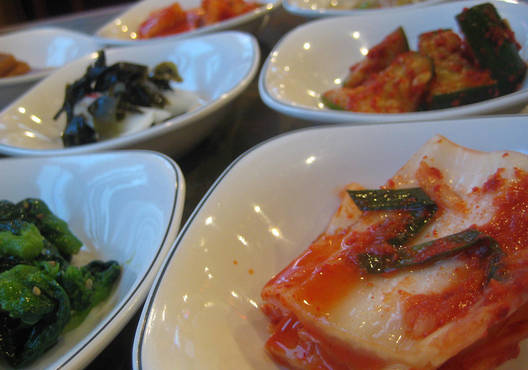
Savour Every Mouthful of Kim's Bob in Robinsons Place's Paseo Iloilo


Food is prepared at your table
Lunch and dinner are popular
Create your own experience


Kim's Bob has many fine offerings for delectable Korean cuisine.


Who could resist the various sensory pleasures of Korean barbecue: the spicy, salty flavours, and the mixture of textures and temperatures (crisp lettuce juxtaposed with succulent grilled meat), not to mention the hands-on fun of going through a pile of lettuce leaves, wrapping your own individual little barbecue sandwiches and popping them into your mouth.

With its modest appearance from the outside, this restaurant is easily overlooked. But as you walk past this restaurant on a busy afternoon and inhale the aroma of beef and pork, you will not want to miss out on the excitement within its walls. The interior decor significantly enhances the cultural and the culinary experience. Their menu is quite extensive and offers many varieties of food, many varieties of meat, and dinner specials which are hearty and filling while being light on the wallet. With their generous offerings in both variety and quantity, Kim's Bob is definitely worth a visit.


Ring (033) 3377950.  They are in for a treat both visually and gastronomically.

And finally, don't worry if you don't like spicy food. Kim's Bob has been in business a long time, and they understand the Filipino palate. They'll make the dishes spicy if you ask, but leave them mild if you prefer. 

Kim's Bob (Korean restaurant)
Robinsons Place Iloilo
Paseo Iloilo
J De Leon Street
Roxas Village
Iloilo City

Cuisine type: Korean
Reservations: Not required
Diet choices: Many vegetarian and vegan options


Saturday, 19 March 2011

This Bird

a poem by Roger B Rueda

doesn’t
chirrup,
chirp,
twitter,
or tweet,
or
ruffle
its feathers.

It's not
everything
I'd ever
want
in a pet –
bright,
funny
and
attractive.

It
faces
me
bravely
the way
I
fight
other birds
to the death.

I
think
I need
a rag doll.

I'm going to
doll
myself up
and
show
it off
to all
bird lovers
as they love
dolls
in the dark
more than
their pet birds.

I want
to see
a bird
fight with
my doll
this time.

Wednesday, 16 March 2011

On Jose Rizal’s ‘An Eagle Flight’

an essay by Roger B Rueda

Juan Crisostomo Ibarra, a young Filipino chap, having graduated and lived in Europe for seven years, returned to the Philippines. Don Santiago de los Santos, a family friend also called Captain Tiago, threw a party for his honour, which was graced with the presence of friars and other well-known figures - Doña Victorina, Padre Sibyla, and ex- San Diego curate Fray Damaso Vardolagas, who derided and insulted Ibarra. Ibarra gave the cold shoulder to the insults, took no offense at what he said about him, and, relatively, excused himself warmly and left the gathering by reason of a supposedly important undertaking.

Ibarra, the day after, called round for Maria Clara, his fiancee, the pretty daughter of Captain Tiago and well-to-do resident of Binondo, Manila. Their ongoing love was undoubtedly manifested in that meeting, and Maria Clara couldn’t help but look back over the letters her dearest had put pen to paper for her before he left for Europe. Prior to Ibarra’s leaving for San Diego, Lieutenant Guevara, a gendarmerie, revealed to him the incidents preceding the demise of his father, Don Rafael Ibarra, a wealthy landowner of the town.

As said by Guevara, Don Rafael was one-sidedly accused of being a heretic, other than being a docile - a claim brought forth by Damaso on account of Don Rafael's abstention in the Sacraments, for instance confession and mass. Damaso's enmity against Ibarra's father is made worse by another incident when Don Rafael helped out on a clash between a tax collector and a child fighting, and the former's death was blamed on him, though it was not intentional. Out of the blue, all of those who thought ill of him went up with further objections. He was incarcerated, and just when the matter was almost straightened out, he died of bad health in prison. Still not pleased with what he had done, Damaso arranged for Don Rafael's dead body to be dug up from the Catholic church and brought to a Chinese graveyard, because he thought it wrong to consent to a heretic a Catholic burial ground. Sorry to say, it was raining and because of the niggling heaviness of the body, the undertakers decided to lob the corpse into a hard by mere.

Settling of scores was not in Ibarra's plans, but rather he wanted to carry through his father's plan of raising a school as he believed that education would pave the way to his country's advancement (all over the novel the author refers to both Spain and the Philippines like chalk and cheese, which form part of a same nation or family, being Spain the mother and the Philippines the daughter). Throughout the inaugural ceremony of the school, Ibarra would have been killed in a disruption had Elias - a mystifying man who had warned Ibarra earlier of a plot to kill him in cold blood - not saved him. Instead the hired killer met an untoward incident and died. The series of events proved to be too hurtful for Maria Clara who got badly ill but was coincidentally cured by the medicine Ibarra sent.

After the launching, Ibarra hosted a luncheon during which Damaso, arriving uninvited at the luncheon, again insulted him. Ibarra closed his eyes to the priest's disrespect, but when the latter disparaged the recollection of his dead father, he was no longer able to bring himself under control and sprang at Damaso, prepared to stab him for his impudence. In consequence, Damaso excommunicated Ibarra, taking this opportunity to convince the already-hesitant Tiago to forbid his daughter from getting married to Ibarra. The friar wished Maria Clara to get hitched to Linares, a Peninsular who had just arrived from Spain.

With the help of the governor-general, Ibarra's excommunication was reversed and the archbishop came to a decision to accept him as a member of the Church anew. But, as fate would have it, some incident of which Ibarra had known nothing about was blamed on him, and he was mistakenly arrested and imprisoned. The indictment against him was then taken  precedence because during the proceedings that followed, nobody could bear witness that he was indeed involved. Alas, his letter to Maria Clara in some way got into the hands of the judges and was manipulated such that it then became substantiation against him by the parish priest, Fray Salvi. With Machiavellian precision, Salvi framed Ibarra and ruined his life just so he could stop him from marrying María Clara and making the latter his concubine.

In the interim, in Capitan Tiago's residence, a party was being held to proclaim the upcoming marriage of Maria Clara and Linares. Ibarra, with the help of Elías, took this chance to break out from prison. Before leaving, Ibarra spoke to Maria Clara and accused her of being disloyal to him, thinking that she gave the letter he wrote her to the jury. Maria Clara made clear that she would never work against him, but that she was compelled to submit Ibarra's letter to Father Salvi, in exchange for the letters written by her mother even before she, Maria Clara, was born. The letters were from her mother, Pia Alba, to Damaso alluding to their unborn child; and that María Clara was thus not Captain Tiago's natural daughter, but Damaso's.

Later, Ibarra and Elias ran away by boat. Elias instructed Ibarra to recline, covering him with grass to put his being there out of sight. As luck would have it, they were spotted by their enemies. Elias, thinking he could outmanoeuvre them, jumped into the water. The sentinels rained shots on him, all the while not knowing that they were aiming at the wrong man.

Maria Clara, thinking that Ibarra had been killed in the shooting incident, was, to a great extent, overcome with angst. Robbed of hope and severely disheartened, she requested Damaso to confine her into a nunnery. Damaso half-heartedly agreed when she threatened to take her own life, demanding, ‘the nunnery or death!’ Unbeknown to her, Ibarra was still alive and able to get away. It was Elias who had taken the gunshots.

On the eve of Christmas, Elias roused in the jungle seriously injured, as it is here where he instructed Ibarra to meet him. Elias, instead, found the altar boy Basilio holding his already-dead mother, Sisa. The latter lost her mind when she learned that her two sons, Crispin and Basilio, were chased out of the convent by the sexton on suspicions of stealing sacred objects. Well, it was the sexton who took the objects and only pinned the blame on the two boys. The said sexton actually slew Crispin while cross-examining him on the supposed site of the sacred objects. It was understood that the body was never found and the incident was hidden by Salví.

Elias, won over that he would die shortly, instructed Basilio to build a funeral pyre and burn his and Sisa's bodies to ashes. He told Basilio that, if no one reached the place, he would come back later on and dig for he would stumble on gold. He also let him (Basilio) know to take the gold he would find and go to school. In his dying gasp, he instructed Basilio to keep on dreaming about freedom for his motherland with the words: ‘I shall die without seeing the dawn break upon my homeland. You, who shall see it, salute it! Do not forget those who have fallen during the night.’ He passed on then.

It was put in plain words, in the epilogue, that Tiago turned out to be hooked on opium and was seen to frequent the opium house in Binondo to slake his dependence. Maria Clara became a nun where Salvi, who has lusted over her from the opening of the book, recurrently used her to fulfil his lust. One tempestuous late afternoon, a fine-looking fanatical woman was spotted at the top of the convent, shedding tears and cursing the heavens for the lot in life it has given her. Even as the woman was never known, it is put it to the readers that the said woman was Maria Clara.

The novel was a call to the affirmation of nationalised distinctiveness and the fight for parity with the vanquishers. With its presentation and examination of Spanish oppressions, it emphasised the need for transformation.

Finished when he was all of twenty-six, ‘An Eagle Flight’ was Rizal's earliest novel. He had already written essays and poems with patriotic topics up to that time.

Jose Rizal was laid blame on of being a revolutionary caused by the general idea of his book, which in a while stimulated revolutionaries in their cause.

Sunday, 13 March 2011

On Philippines Education

an essay by Roger B Rueda

Philippines education sucks. I don't know, our government doesn’t place great importance on education. This, in consequence, is no negligible issue. Equality rests or collapses with us and our habits of mind, and education produces habits of mentality. We, even so, are seeing deep-seated changes equally in pedagogy and curricular content, and these changes have not been well thought throughout. Keen for cost-effective intensification, this nation, like many others, has begun to think of education in barely instrumental terms, as a set of practical skills that can create quick-fix turnover for business (of other countries, perhaps). What is getting misplaced in the cutthroat outbreak is the opportunity of social equality.

We, as citizens, need to tend the ability to pass judgement on practice and authority, to keep examining self and other, to accept no talking or suggestion until we have tested it with our very own way of thinking. We have a disquieting capability to defer to authority and to peer pressure. Social equality can’t go on if we don’t limit these baneful tendencies, cultivating habits of intrusive and critical thought.

We also could do with historical knowledge, the basics of the major world religions, and how the global economy works. We need to learn to weigh up evidence, to think for ourselves about the unusual ways in which it can be put together, and brought to bear on current reality.

The humanities, the arts, and even history are being cut away to make room for profit-making skills (or merely profit-making by schools). When such changes are made, business itself suffers, because healthy business cultures necessitate ingenuity and critical thinking, as leading business educationists have long stressed. Even were this not factual, however, the liberal arts are essential for the sort of government we have chosen and for the sort of the Philippines we have long sought to be.

The role of education is extensively understood to be essential in our society for both the encroachment of the nation over and above the enhancement of individual life. The power that results from learning provides people with the ability to do well physically, rationally, and psychologically, and contribute their resources to the betterment of their environment. The fact that a person who has worked hard at his or her education will be offered countless opportunities for his or her future is something that no one can contest in our culture, because it is based on a philosophy that has fueled the growth of our country. But it seems that only a small number are working hard.

The Philippines has need of public education in the hope that everyone would be offered an equal opportunity to realise this dream and to pursue a life full of goings-on and dispensation. Yet, when it comes down to it, this presumption has failed to provide each student with the same opportunity to accomplish his or her goal and instead has only fostered isolation, bigotry, and mass disproportion.

The biggest problem in our public educational system is the relentless lack of financial support and the gross inequalities that are present amongst schools. While many children of middle and upper class neighbourhoods are given the material and intellectual resources that will allow them to get hold of high social standing, solid employment, and wealth, many other children are denied this dispensation because of their economic background and location. Observably within almost any society there are going to be varying levels of material goods and power, but it seems that in the Philippines, the dissimilarity between rich and poor is greatly puffed up. How is it that low-income populace are not being offered the same resources as superior class citizens? It is this lack of fiscal resources in poor neighbourhoods that is the foundation of all the other problems found in the individual district schools. Unproductive and inexpert teachers, textbooks, lab instruments, and general supply insufficiency, and inapt building conditions all stem from the fact that there is not enough money being put into such institutions. However, because of both societies’ approach towards the low-income class and personal greed, this fiscal disproportion is not going to change; political power, and public unresponsiveness also contribute to the overall lack of knowledge of the problem.

The educational system is an institution that is not only an integral piece of our social structure but also is responsible for teaching children the fundamental learning tools, simple values, and social skills that are essential for continued existence in our culture. The facility to read, write, solve problems, and understand numbers is essential for almost any job, and knowing how to interact with others in a social context or in the workplace and respect authority (as in a employer-employee bond) is vital if one intends to work or even live in our world nowadays, and these are all things that are taught in school, through positive student-teacher interactions and class coursework. The perspective on how a society stays together is based on the idea of a set of agreed upon norms, beliefs, values, and expectations of appropriate behaviour that is to be internalised by each individual. Consequently, if education serves the purpose of instilling this harmony, when all the public school students are not held to the same set of standards, there is going to be a mainstream of the population that will not be capable to fulfil a task in our society, and thus accordingly will become a strain on the other parts of society as a whole. A malfunction of one part of society that interferes with the smooth functioning of the whole, is a social problem, and then, the movement towards testing and answerability is trying to lighten the pressure that our current system has upon institutions like the economy and family structure. 

The biggest problem, in terms of what the primary issue in education is today is the lack of funding that occurs in schools all over the country, as well as the fact that the massive disparity, so clearly perceptible within our system, receives such little attention from the public and accordingly remains up in the air. Reading about the wretched building conditions, the lack of proper educational resources, and the inefficiency of the teachers was to me such an unknown and sickening impression, because I have led a life full of unbinding freedom; that these kind of situations and circumstances exist in such alarming numbers is, in my opinion, totally undesirable and immensely duplicitous of our country. It would not take much money from each individual to restore schools and perhaps even whole neighbourhoods; and the fact that personal greed plays such a huge role in the withholding of monetary support is disgusting of us as humans. The fact that in the Philippines, there are children crammed into decrepit classrooms with uninspiring teachers, no books, no hope for a better future, and little solace from the harsh realities of life is a self-mockery.

On university education, our government is handing over millions of pesos to incompetent professors in state universities. Incompetent university professors are good for nothing. The Philippines has no framework of higher education that can match up to the rest of the world. The universities are a quagmire of despotic professors. The PhDs can not function in the real world. There is no standard of research in the country in hard sciences or social sciences. Knowledge is passed by rote and memorisation in a continual loop from teacher to student to teacher. Teachers do not undertake or tolerate critical thinking. Any old place can slap a university sign on the door and become an accredited institution to meet the criteria for government financial backing.

I think our educationists and politicians should require all graduate applicants to take the GRE, set up tenure review and administrative review, push student unions on campus, strengthen cultural and social discourse and, most beguilingly, exert a pull on Filipino teachers.

Our education should give us a sense of place, instil in us much self-confidence and self-worth, and give us the power to do something good with our life. Does it? The notion that there are thousands of students just that are being shorn of this opportunity because of either their economic status is nauseatingly inequitable in my eyes. I sense that the more pressing issue lies in the already present dreadful circumstances in which a lot of poor students are being taught, especially because it is a problem much easier to tackle and would have such discernible and perceptible results. It is unmistakable that with apposite fiscal organisation and support that this problem of inequity could be easily solved, and would in turn help assuage the burdens of many other issues that come to pass within hard-up neighbourhoods about the country. Teenage pregnancy, drug use, and other problems still would turn into many families all but dysfunctional. The family, though, differs from the school in the considerable respect that government is not conscientious, at least not directly, for the inequalities of family background. It is responsible for inequalities in education. Schools, on the other hand, could make striking changes almost overnight if fiscal equity was a reality. I blame our government for not taking the fitting actions to resolve the situation. It cannot be disregarded that in each social system there are going to be people better off than others, but it is the job of each citizen and each elected official to make certain that every single person is in any case given the prospect by any means possible to make it.

Sunday, 6 March 2011

Felt Desperation

an essay by Roger B Rueda

The life of the poor is not a pleasant life of simplicity in contemporary Philippines. It is an unvarying struggle, a constant fight, an unvarying pasture of contending chances, opposing tasks, commitments, and necessities, a continuous attempt to accomplish the unworkable. For many at the underside of our social ladder, a legally recognised, honest life can at times look as if to be an obvious hopelessness.

A lot of poor children in urban Philippines often find themselves fighting to stay alive each day. These children often go without food, water, health care, and education. Time and again, they also face each day with no hope. Some astonishingly dreadful things - like glue-sniffing boys ambling down the streets of Iloilo City, with impunity - never change (they conduct their self-destruction without fear of being challenged by passersby or social workers) - basically because people are ignorant that it is their own indifference to, and tolerance and acceptance of this and other ignominy, mistreatment, decay, dreadful conditions, and dysfunction that allows tremendously noticeable tragedies like this to persist for many years and take their appalling toll. Many young, poor, slothful, uneducated glue-sniffing victims are not only abandoned, but whose public self-abuse is readily accepted and tolerated in this city. Young glue-sniffers are in many places in Iloilo City, out in the open at night.

A lot of poor Filipinos go through a sticky patch these days. For instance, they have to keep buying mobile phones worth Php 500 or less as they’re what they can come up with the money for, and then having the phones go kaput on them, because there’s not a Php 500 phone in the Philippines that’s worth a blameworthiness.

They just hope their terrible toothache or stomachache or headache makes well. They can’t even find the money for a paracetamol or ibuprofen.  And to a greater extent poor people live at the side of the streets. It seems paradoxical to me, developments are in evidence.

They get unsafe China toys for their children, the government officials imprudent and negligent about this problem even this has caused colossal loss to the national economy. Their house does not have enough room for each one who lives with them. Things are seldom what we seem, they are more of canned sardines. They most often feel the glued soles tear off their shoes when they run about the park. Their child’s school has 30-year-old textbooks and no air conditioning, the donors of the books think the books are what they ought to have even supposing they can provide better ones. They are not out of their depth to donate rubbish books.

They think Php 100 a day is a really good transaction. They put their faith in people who don’t give a damn about them. They stop the truck to take a lamp or old bits and pieces from a stranger’s rubbish. They don’t mind even if, while making lunch for their child, a cockroach or mouse skitters over the food.

Poor and illiterate people are misused during election campaign. They are all given freebie meals and pocket money. Elections are the only time when they get the recognition.

They keep on believing that a degree from a state university can actually make a difference even though the professors are not up to it and even though their prospectus doesn’t fit to their aptitude or even probable work at some point. Some people are annoyed at them just for walking about in the shopping mall. The police force busts into the house right next to theirs. These problems spawn more severe corollaries that make this society more squalid, intellectually, morally, and religiously.

The way they talk has turned out to be a basis by most people as to know a bit about them. Evidently, possibly because being poor has become a label, and prevalent. Aren’t we making a peat bog to make this country a gigantic quagmire of paucity or adding exasperation to this curse?

They work as hard, too, as any person, wherever, in the periphery of dishonesty, discrimination, and disproportion, however. They shocked us as we learn they are not really brainless and they are not actually indolent. They have to pass the time in a casualty with a sick child dead to the world on their knee for six hours. See? This society is unfeeling, I don't know. The poorest sections of our society are not empowered because we are rapacious, especially our politicians and businesspeople.

They are always judged. Their cough doesn’t go away. Their eczema stays as if it was permanent. Their goitre, visible as distension at the front of the neck, seems to be a curse put on them. Many die with it. They have few choices. They grin with missing teeth. For many, it is hard to stop their being poor. I think so. This society is so thoughtless. They, though, are disposed to give a gift certificate worth Php 500 to a well-off friend but detest to give even a peso coin to a tramp.

By reason of poverty caused by this society’s avarice and thoughtlessness, a lot of children cannot go to schools, even to a school with 30-year old books. They only watch others go to schools and can simply wish to seek knowledge. It is on account of a lot of hindrances and difficulties - desperate conditions that they face in life. Having been forced to kill their aspirations, dreams and other wishes, they are pressed to earn a living for themselves and for their families. So then this country has lot of child workers. These children work due to the psychological, social, and materialistic pressure. Isn’t the nation’s future namely children shorn of pleasures of life? Well, ignorance has reduced their abilities of thinking right or differentiating between right and wrong, as well as their life-chances, to their non-access to education.

This problem on poverty calls for swift action from our government, from people who have the power to change things by far, and from the churches that think religious belief is a justification for this negligence. Due to having a large family already, combined with financial and/or medical privation, poor people should espouse the use of artificial contraception for the purpose of preventing more children. It is a national problem that needs to be taken in hand by all of us.

For one, as poverty is getting worst, poor people won’t be stopped to steal from people - relatives, associates, neighbours, unfamiliar persons. Others are tempted towards prostitution, a nightmare of squalor and ill-treatment for all concerned or are trafficked under false pretenses, such as jobs, then are forced into prostitution in brothels. Others are talked into to carry illegal drugs into other countries even though it means death penalty when proven at fault. Others twist their arm towards suicide.

And when we, as a society, are found time and time again not to be up to snuff to elevate those at the very base, let us not castigate or punish them for trying to continue to exist as best they can, as they rob, burgle, kill, take advantage of others, pimp, shoplift, swindle others out of thousands of pesos, steal things out of pockets or bags in a crowd, and agree to carry illegal drugs into another country./ Panay News Sunday

Sunday, 27 February 2011

Some Novel Words to Bask In This Sunday

an essay by Roger B Rueda

Learning new vocables takes us beyond ourselves. We broaden our points of view, gain knowledge of new facts, and come to a better understanding of the world and our place in it. Vocables can support us when we are exchanging a few words to other people. Here are a number of vocables of uproarious importance (perhaps) I have come across this week:

ART BUM. A person who is on the edge of doing art work, be it writing, acting, playing music, or otherwise. Even though this person thinks about being artsy and doing art incessantly, he or she hardly ever does it. That art bum thinks she'll be the next Picasso, but all she does is have her head in the clouds.

BLAMESTORMING. (1) A meeting intended to find out why a cut-off date was missed or a task failed, and who was to blame. I just got out of a three hour blamestorming meeting with IT about the server collapse last week. Someone's going to end up in joblessness over this. (2) Sitting around in a group discussing why a deadline was missed or a project failed and who is responsible. Oh, great, we lost the transaction. Time for some more blamestorming.

BREAKING THE SEAL. Your first piss at the pub, usually after two hours of drinking. After breaking the seal of your bladder, repeat visits to the restroom will be required every ten or fifteen minutes for the rest of the night. I broke the seal in bogs, after that there was no stopping me.

CLOSET BITCH. A girl who appears to be very nice and pleasant but is secretly tremendously hateful and dislikes everyone who she pretends to be nice to. Ronelo was convinced Cynthia was an angel until she slapped him in the face for no apparent reason, that's when he realised she was a closet bitch.

CUBE FARM. (1) A cluster of cubicles in a workplace. From the top down, they look like an art farm or bee nest, hiving productive little workers into their cells. I'm glad I have my own office now, escaping the dreaded cube farm. (2) The vain attempt to produce privacy in an otherwise open-office layout through the placement of shared partitions in a box-like arrangement around each adjoining work area. This lousy office hive is nothing but one big fucking cube farm!

FILIPINO PAINT JOB. After the completion of sloppy anal sex, the faeces remaining on the penis of the ‘painter,’ are smeared on the back of the recipient. It is then ‘white washed’ with the semen of the painter. Two hours after eating at Blue Ocean, and fifteen minutes into some hot anal action, Jet pulled out and gave that whore a Filipino paint job.

404-UNABLE TO WOO. When a geek tries to hit on someone out of his or her league and gets rejected. The geek is then unable to woo the person he or she is hitting on. It frequently comes in the form of a disgusted facial expression or the person walking away from the geek looking like he or she saw a ghost. It was named after the notorious 404 web page error that occurs when the page is unavailable. Manuel tried to offer the woman a beer but instead got a 404-unable to woo when he approached her.

GAY AND A HALF. When someone is acting so brainless and capricious that you can't simply call them ‘gay.’ Hey, Clem, look at me stick these straws up my nose! ~Alexis, you're gay and a half!

GAY AS A FISH. A guy who is visibly and indubitably gay. It is more often than not used to alert another dude who's blind to the clues and doesn't take in is being picked up by him. Martin: Hey Rafy, have you met Ricky? He's such a cool guy. Rafy: Is that the guy in your class? Martin: Yeah! He and his roommates are throwing a party at his place and he said we're invited. Rafy: Dude, this guy is gay as a fish. If I were you, I'd watch my back.

GOING FOR A MCSHIT. When you go into McDonalds for the only intention of using the lavatory. Please note: If challenged by the spotty staff member, then your declaration that you will buy food afterwards is a McShit with lies.

GOSSIP VULTURE. A person who only befriends you to learn gossip, and then passes it on. An accepted journalistic activity, but also widespread somewhere else. Frances is a true gossip vulture. I told her about Luis and she's mistreated me since.

JOHNNY-NO-STARS. A young man of substandard intelligence, the typical adolescent who works in a burger restaurant. The 'no-stars' comes from the badges displaying stars that staff at fast-food restaurants often wear to show their level of training.

MONKEY BATH. A bath so hot, that when lowering yourself in, you go: ‘Oo! Oo! Oo! Aa!Aa!Aa!’ Martin in bathroom: ‘Oo! Oo! Oo! Aa!Aa!Aa!’ Edmond: ‘Haha sounds like Martin is having a monkey bath!’

MYSTERY FRUIT. A person who may or may not be ‘closet gay.’ Jimmy: So did Ricky ever come out? Prince: No, he's still a mystery fruit.

SEAGULL MANAGER. A manager who flies in, makes a great deal of noise, craps on everything, and then leaves. Rafy never accomplishes anything. All he does is come in here every now and then, complain about deadlines, puts more work on us, then goes back to surfing the intraweb. He's such a seagull manager.

SHOPPERLIFTED. When a cashier forgets to put items in a customer's shopping bag and they depart the store without them. Again and again, the shopper will return home, empty out their goods, and find out in outrage the lack of certain items. I thought I just bought toilet paper?! ~Haha, it looks like you just got shopperlifted.

SWAMP-DONKEY. An incredibly unsightly, usually fat girl or gay who hangs about in pubs and clubs waiting to sexually assault males who are too drunk to defend themselves. Damn! Look at her! What a swamp donkey!

TARTANGLE. To feel mortified for someone in a cinema film even though you are not part of the scene. Oh my god the entire ‘She's the Man’ is a giant tartangle!

TESTICULATING. Waving your arms around and talking total bollocks. It is best for use when managers, advertising types, or TV producers start spiralling out of control. Stop testiculating and give me a straight answer, if you can.

UGLOID. A very ugly person. No, I am not going out with that ugloid!

UGLORABLE. When describing something that is all together ugly and adorable. The vocable that results from the combination of the words ‘ugly’ and ‘adorable.’ Oh, that pigmy hippopotamus is absolutely uglorable!/Panay News Sunday

Monday, 21 February 2011

Looking Back on the People Power Revolution

essay by Roger B Rueda

I was all of six then when the People Power Revolution came to pass, but I have vivid memories of it, though, to some, it’s just a dim memory for them now. Every time I hear the People Power songs Magkaisa (by Virna Lisa Loberiza) and Handog ng Pilipino sa Mundo (by Apo Hiking Society), their tunes really bring back memories. They awaken poignant memories of vicious days.  That is, those I saw on TV, newspapers, and magazines. I have a very vivid picture of the first time I saw former president Corazon Aquino on TV. Later on, after 10 years, I buried myself in one of her magazine articles I set aside in my baul. I realised how brilliant, remarkable, cool her ideas were. I’ve really thought highly of her phraseology.

Our history books and oral history, by the way, put us in the picture that it was a string of passive revolutions and prayerful street protests in the Philippines that suggested itself in 1986. It marked the refurbishment of our country’s democracy. It is, now and then, described as the Yellow Revolution owing to yellow ticker tapes during the coming of president Benigno Aquino III’s father, Benigno, Jnr, the senator who could perhaps put back president Ferdinand Marcos but was snuffed out at the tarmac. These protests were the finale of a long crusade of civil struggle by the people against the 20-year running relentless, tyrannical government of authoritarian president Marcos.

The greater part of the demonstrations took place at Edsa in Quezon City, and drawn in over two million Filipino civilians on top of several political, military, and religious figures. The protests, fueled by a battle and antagonism of years of shady ascendancy by former president Marcos, occurred in February 1986, when Marcos took off Malacañang Palace to the Hawaii and conceded to Corazon Aquino, Asia's first female president, as the lawful leader of this country. Just last year, the then president Gloria Macapagal Arroyo said: Cory Aquino helped lead a revolution that restored democracy and the rule of law to our nation at a time of great peril. She picked up the standard from the fallen warrior Ninoy and helped lead our nation to a brighter day.

Some military leaders, dismayed by the evident election irregularities, set into motion an attempt of coup d'état against Marcos. The early plan was for a squad to beat up Malacañang Palace and take Ferdinand Marcos into custody.

When Marcos, however, learned about the scheme, he ordered the apprehension of the mutinous leaders, and presented to the international and local journalists some of the captured conspirators.

On the 22nd of February, as dawn was breaking, Juan Ponce Enrile, then AFP chief of staff, and Fidel Ramos, his vice chief,  publicised that they had given up their their positions in Marcos's cabinet and were withdrawing support from his administration. Marcos himself in a while conducted his own news conference calling on Enrile and Ramos to capitulate.

Cardinal Sin urged Filipinos to come to the aid of the mutinous leaders by going to Edsa stucked between camps Crame and Aguinaldo and giving emotional support, foodstuff, and other provisions. For many, this looked as if a risky choice since civilians would not stand a chance against dispersion by government troops. Nonetheless, a lot of people, mainly priests and nuns, came to Edsa in droves. It was believed that the radio, Radio Veritas, had played a decisive role during the civil disobedience.

Marcos talked to US senator Paul Laxalt, asking for counsel from the White House. Laxalt advised him to cut and cut cleanly, to which Marcos expressed his dissatisfaction following a short awkward moment. At 9 in the evening, the Marcoses and their allies were transferred by four US Navy helicopters to Clark Air Base in Angeles City about 83 kilometres north of Manila, before getting on US Air Force C-130 planes heading for Andersen Air Force Base in Guam, and lastly to Hickam Air Force Base in Hawaii at which the Marcoses arrived on the 26th of February.

As the news of Marcos's going away was relayed around, a lot of people expressed joy and bopped to the music in the streets. The protesters were finally able to go into Malacañang Palace, long denied to ordinary Filipinos in the past decade. Works of art were pillaged from the palace, but by and large people moseyed on down to every corner of the palace, looking at the place where all the pronouncements that changed the course of Philippine history had been made.

A lot of people around the world were glad and passed on good wishes to Filipinos they knew.

The 25th of February 1986, a notable Metro Manila event that has been carved in the hearts and minds of all Filipinos, be it in person or on TV or the radio, gives us a strong sense of pride especially that other countries had tried to follow what we have made known in the world of the true power of a democratic system, such as in Egypt, shown on the BBC just two weeks ago. It was a day that drawn all Filipinos together in unity with bravery and devotion to win through democracy in this country. It was the power of the people, who assembled in Edsa, which brought back the free Philippines, ending the unfair Marcos rule.

Now, far away in the north of this country, the corpse of the former president Marcos, who departed this life in exile in Hawaii in 1989 after being removed from power in the popular protests, lies in a refrigerated vault.

For years, his wife, Imelda, has campaigned for his remains to be given state honours and a hero's burial.

Marcos is so discredited - and his wife so maligned in the press for her lavish lifestyle and corrupt associations - that she has little chance of ever realising her goal. Is it not anachronistic and ridiculous?  Can there be no general rule about how a dead exile leader is to be treated?  Well, it all depends upon the judgement the present society passes on him. Indignity or ignominy, it is better to dispose of the mortal remains without much ado. If I were his wife, I’d have him buried in remote plots of land without fanfare. Let’s bear no animosity towards president Marcos.

Anyway, Happy People Power Revolution Day!/Panay News Sunday

Friday, 18 February 2011

The Forbes Bridge under the Iloilo River

a poem by Roger B Rueda

1996.
As I looked down into the river
at the sound
of the boat
while I was crossing
the Forbes Bridge,
the water stared
blankly at me,
discarded
toothbrushes,
combs, cups,
and plastic
water bottles
so colourful
iridescence,
two young men
sitting side by side
at the back
of the raft,
chatting
and enjoying
the river view
while sending out.
2011.
Every time I look
down into the river
at the sound
of the boat
while I am crossing
the Forbes Bridge,
the waterway
is dotted
with shrubbery,
buildings,
and hoardings
that pierce
into the sky beneath.
I watch a flock
of birds
flapping their wings
under the bridge,
leaves whirling eddies behind.

Sunday, 13 February 2011

Love


an essay by Roger B Rueda

Eons have gone by, relationships and affairs have come into flower and so has love. No one, nonetheless, can describe what love is, carefully. Personally, love is intimacy bubbling over for others. Perhaps, love is like good fortune, you have to go all the way to get it. In spite of how we delineate it or consider it, love is the timeless truth in the times past of humans.

As if by magic, love is serene and soft. It has no resentment, nor it sings its own praises and it is never swollen with pride. It expresses joy over malevolence and tries to find the truth. It saves from harm and preserves and wishes for the positive facet of life. It is like the dream coming true.  It can come about amidst us. It can bond us and connect us in a unified tie of belief, familiarity, and interdependence. The relationship can perk up at it. It relieves the soul. Love should be felt. The strength of love cannot be measured: take a look at the relationship between a mother and a baby. The mother loves the baby absolutely and it cannot be measured humanly. A dissimilar facet can be attained between any relationships with the enchantment of love. Love can be created. You just need to concentrate on the kindness of the other person. If this can be done by far, then you can also love by far. And commit to memory that we all have some positive aspect in us, regardless of how ghastly our deeds possibly, as God affirmed: Love each and every one.

Love is deep, intense, and continuous. It is shared on a very close and interpersonal bond. It is also matter of great warmth. It is more of craving, fondness, and way of thinking. Love has profundity, versatility, and intricacy. It helps us to experience ourselves again. It is like small gestures that speak volumes about how much we are concerned.

Every so often, the very existence of love is questioned. A few say it is artificial and pointless. It seems it never exists, as there have been countless instances of abhorrence and cruelty in relationships. The history of our world has seen scores of such events. There has been loathing amongst brothers, sisters, parents, and buddies. Associates have been disloyal to each other. The son has killed his parents for the throne, the estimate is infinite. Even the modern generation is also facing with such a catch-22 every day. But love is not at fault for that. It is us, the people, who have closed the eyes to the essence of love and have undertaken such shocking indifference.

Love has, for ever and a day, ruled, in letters. (Here are a few: (1) Love Story by Erich Segal, (2) Message in a Bottle by Nicholas Sparks, (3) Wuthering Heights by Emily Bronte, (4) The Thorn Birds by Colleen McCullough, (5) The Notebook by Nicholas Sparks (6) Jane Eyre by Charlotte Bronte. Jane Eyre, (7) Like Water for Chocolate by Laura Esquivel, (8) Outlander by Diana Gabaldon, (9) Love in the Time of Cholera by Gabriel Garcia Marquez, (10) A Walk to Remember by Nicholas Sparks, (11) The Fountainhead by Ayn Rand, (12) Written on the Body by Jeanette Winterson, (13) Romeo and Juliet by William Shakespeare (14) The English Patient by Michael Ondaatje, (15) My Antonia by Willa Cather  (16) Mistral's Daughter by Judith Krantz, (17) Persuasion by Jane Austen, (18) Love in Another Town by Barbara Taylor Bradford (19) Pride and Prejudice by Jane Austen, (20) A Farewell to Arms by Ernest Hemingway.)

Love is a far above the ground form of forbearance. It consists of compatibility. But it is more of voyage to the beggaring description when the conception of compatibility comes into picture. Perhaps, the person who we see in front of us, may be slightest like-minded than the person who is miles away. We might talk to each other and reveal that we love each other, but virtually we do not end up into any relationship. Also in compatibility, the means is to think about the long term flourishing relationship, not a short voyage. We need to be aware of each other and must always remember that not a soul is just the thing.

Love can make us placid, uncomplaining, compassionate, self-effacing, thankful, selfless, understanding, and giving. It is what keeps us from being insufferable, mean, green with envy, full of ourselves, pompous, worthless, and discourteous. It helps us not to clamour for having our own way repeatedly, and it helps us not to be tetchy or spiteful.

Love helps us judge with our hearts and not with our minds.  It is considerate towards others, is not hurtful or condemnatory, and it gives us the strength to excuse others. If we let love cross the threshold our hearts, we can see more of the good in others and do not see as many faults.  All the things that seemed wide of the mark to us begin to look right again when we look at it through the smoothness of love's tender luminosity.

We need to be in somebody's company, share our delight and grief, understand each other, provide freedom to each other, but always be there for each other's need. And for sure love will come into bud to strengthen our relationship with our matter of affection. Then it’ll grow and come into flower. Its terrific beauty will shine from the rest. Its radiant fragrance will hang around aloft. We’ll see then it is colourful but has a prickly stem when you lay a hand on it. Though we sense the twinge, we should still keep hold of it tighter time after time. Happy Valentine’s Day!/Panay News Sunday


Saturday, 5 February 2011

Fictionists

a poem by Roger B Rueda

I want to know the whole lot about you,
what brand names of shampoo
and soap you avail yourselves of,
what cars you drive,
what shirts and denims
you show off,
which cafés you eat in.
All this and more
by a hair's breadth matters
and makes
a difference to my life.
No. Certain episodes, I mean,
in your voyage
which brought you
closer to the aspirations
when shared,
and help me in my mission, are.
That’s what your writings
are all about.
They are nothing but a foretaste
into your spirits. They are you.
I am not thinking likely
to story of your lives.
There will come
a point, though, in your lives
when you don’t feel like
hiding anything from view.
They are standing by
to share their deepest secrets
as their mind is forbearing.
That is an incalculable incident.
Possibly that will happen
to you. I hope before long.
No one will always recognise
everything
about us, there is providentially
a small repository in our heart
that only lets out
what we want to let out.
I have buried myself in you.
I definitely read about him
in all the books I have read no further,
I read between the lines,
and try to catch the meaning
of the sentiment he
is trying to put across,
which I on occasion am aware of
is more well-defined
in his own vocables.
His judgement is challenging,
and I think he still has lots
of questions,
more than answers.
Not all, again, but people
who feel you as friends,
gracious souls to civilisation
shouldn’t be dismayed
about your voyage
as it is part
of your cultural occurrence
in life. The consequence
is you and that is
what we feel close to
as much as to feel you
as friends. Real friends
don’t judge all actions,
instead they just
hold close and lend each other a hand.


Friday, 4 February 2011

Storytelling

a poem by Roger B Rueda

It is the only granny knot left, we know,
or only some of us,
once we see this coming to blows
of the world.
We share our souls through it,
through prose, through texts
like black water set in paper
or vocables haunted
by the spirit of thoughts.
It has stacks of resonance.
When she buried herself in a work,
she had to stop as she was
taken aback. She thought
How could he know
about me?
Why has this work come
into my life?
She felt like it was about her time
and had to stop
and let her kindred spirit know about it.
She met her kindred spirit
when she was all of ten,
they were family friends,
but she never recognised him.
But she remembers, even then,
longing
for her kindred spirit.
It wasn’t until she was all
of twenty seven
and had loads of experiences
where she thought she had met him
but to find it not so,
that she saw her kindred spirit
after many years of not seeing him
and only hearing about him
and rarely running into him.
She got news, sad news, and went
to see his family.
When she saw him, she felt the pull
of the cosmos to go to him
and hold him close,
so she did. It was like the world stopped,
the crammed full room
with peering eyes
were as nothing
and he was the only one
in the room. She saw luminosity
in him,
she saw all.
She felt like she never
understood life
till that moment.
As they held in each other’s arms
she heard a voice utter
he is the one,
he is the man
you will get hitched at some point.
You’ve by now been
married, in fact. She felt the shock,
incredulity,
wholesome delight.
How could this man
she had known most of her life be
who he was?
He looked at her absorbedly
and she knew he was experiencing
it, too.
It took ages of struggle
and even interlude of peace
to believe
him and he to her.
She felt from that day
she saw him that
there was no one
in the world she could be
in love with
more and she needed to be a piece
of his life,
that he was a part of her, too.
They wound up
in a link of consequence,
but not anything could bring
their flame
to a halt,
not even themselves.
They rarely spoke,
and if they did they broke silence
through the idiom of the cosmos,
their vigour. She knew
when he needed her even
when he was miles away
and he to her.
Now, her kindred spirit
and she smooth the way
to go behind their dream and
hound their own fairy tale.
He really is a little bit of her
and she to him,
their connection is sacred,
substantial, caringly,
absolute, just right.
The tale came into her life
when she, too, was searching
for the augurs of the world.
She had been trying to chance upon
understanding of things
that she couldn’t realise
(like her kindred spirit’s being
and link).
She had been talking
to her kindred spirit about moving
somewhere far-flung.
She had felt like
that was their home.
She had had a very strong tie
with a pernickety part and felt
a connection with the surowanos
many centuries ago.
When she buried herself
in the hardback,
it was like lights going off.
She finally understood
her need to go there be there,
the dreams she had been having
and also her surowano links,
the design straight off,
as she didn’t believe.
That same voice from many years
before rang
that in a past life
she was a surowano.
She knows this is an incredible legend,
but that is why she is sharing it.
Her belief and her whole lot
she was taught to believe went
against the idea of rebirth.
But how could she disagree with it
after meeting
her kindred spirit from a past life?
If she had one life with him
and reminiscences
of surowano life then anything
was realistic.
She is grateful to the person behind
the work
for helping her
to agree to and be glad about
the magic in her life.
She believes the work was a book
from her creator to her.
Her kindred spirit and she
will be going out somewhere
far-flung
to follow a dream.
Their life is justly magical,
beautiful,
superb, to them. This is her tale,
it doesn’t have to be anyone
else’s, but she knows and
can make clear to you
that kindred spirits
do keep their heads
above water,
that if you are looking
for yours, you shouldn’t
ever bow out.
This enraptures my heart
and rivets my mind,
it states virtue in the smoothness
of sentiment, it turns into truth
in the billows of perplexity
and trickery.
Is it to have reality
the uppermost emergence
of magnificence? Perhaps.
Love and audacity are born from it.

Thursday, 3 February 2011

Magic

a poem by Roger B Rueda

Is it the belief of our heart,
of the mind's eye,
or of the delight
that we bring
to the world?
Is it magical
to sense a spirit
on other people?
Now and again I am
at a seaside
beyond belief,
watching
a piece of life
like a tree, sparkling,
whispering
its secrets,
or a butterfly,
flittering
from blossom
to blossom,
every so often pausing
to have nectar
or rest its wings.
Are these magic
flashes,
not being a piece
of the world, but
more like
being a piece
of glory, and
I could have
my home
there undyingly,
colourful
chitin shells
entertaining
the eye and
delighting
my soul?
Is it a viaduct
stuck between
the substantial
and the hidden?
This bound
slouches
itself in awfully bare ways.

Wednesday, 2 February 2011

Life

a poem by Roger B Rueda

What drives it? Is it its end that drives it,
the imprint that defines it
after it's long gone,
its impact on this civilisation,
though it’s barely a fleck?
Or is it nature,
nature makes well and nature drives,
as we know?
Or is it to go behind the signs?
The signs, to some of us, are our lot and idea,
we know that after every sign,
we will have the chance
to take a bit from the world
and also give a bit to the world.
We always go after the signs,
perceptibly:
they go in front of us to our creator.
We trust in our signs and, thus,
we trust in ourselves.
One day we’ll be so close
to our intention
that we’ll have the get-up-and-go
to make thousands of people
feel providential and at ease,
and we’ll have so much love
to give
that we’ll be in this world for others:
that is the only life worth to live.
The next good morning
of each beautiful day
is our vigour of life.
Or does it seem to be transformed
to keep us wide awake
and make our life feel out
of the everyday
and lifting enough?
I´m not clear in my mind
if that is fine!
We just need to rock the boat!
Is it that we want to live
as we know our loved ones
want to see us live to tell the tale?

Sunday, 30 January 2011

The Exuberant ‘Last Lecture’

an essay by Roger B Rueda

I happened to read ‘The Last Lecture’ by Randy Pausch because a friend of mine had swapped the book for my ‘The Valkyries’ by Paulo Coelho. ‘The Last Lecture’ is much more than an anecdote of a man living his final months knowing he has barely months to live. It is on being a spouse, a father, a professor, an acquaintance, and a man. It's about dealings with parents, spouses, children, friends, colleagues, students. It's on passion, belief, enthusiasm, kindness, and almost certainly much more than I was able to take hold of from reading it. There are quite a few parts which I think are signs of jollity, unpleasantness, hilarity, poignancy.

Randy Pausch stood in the company of four hundred spectators at Carnegie Mellon University to deliver a last lecture labelled ‘Really Achieving Your Childhood Dreams,’ on 18 September 2007. With slides of his CT scans beaming out to the viewers, he told them about the malignancy that is getting through his pancreas and that will claim his life in a matter of months. He, on the stage that day, was young at heart, full of life, fine-looking, often with a smile, intriguingly witty, seeming indestructible, although this was a pithy moment, agreed as he himself.

Randy’s lecture has become an observable fact, as has the book he wrote anchored in very similar ethics, celebrating the dreams we all do our utmost to make certainties. Randy, dejectedly, lost his fight to pancreatic cancer on 25 July 2008, but his bequest will go on with to enthuse us all, for generations to move towards.

‘The Last Lecture’ goes further than the now-famous lecture to rouse us all to subsist each day of our lives with reason and delight.

We, Randy Pausch avers, cannot change the cards we are dealt, just how we play the hand.

Countless professors give talks titled ‘The Last Lecture.’ Professors are asked to consider their downfall and to mull over on what matters most to them. And as they tell, spectators can’t help but muse on very similar question: What insight would we impart to the world if we knew it was our last chance? If we had to vanish tomorrow, what would we want as our legacy?

Randy Pausch, a professor of Computer Science, Human Computer Interaction, and Design, when asked to give such a lecture, didn’t have to envisage it as his last, since he had of late been diagnosed with life-threatening cancer. But the lecture he gave - ‘Really Achieving Your Childhood Dreams’ - wasn’t about on its last legs. It was about the magnitude of overcoming hurdles, of making the dreams of others possible, of grabbing hold of every moment (as ‘time is all you have...and you may find one day that you have less than you think’). It was a rundown of the lot Randy had come to accept as true. It was about existing.

The professor, in this paperback, has combined the humour, inspiration, and intelligence that made his lecture such an experience and given it an ineffaceable form.

In burying myself in ‘The Last Lecture,’ I was intensely enthused and stimulated by Randy Pausch’s weighty message about making our dreams come true. He is a muse and I can definitely relate to parts in his lecture specially when he refers to the best of the gold’s at the bottom of barrels of crap because every so often we must get through intricate experiences to attain our dreams. I really consider that, his fulfilment of his dreams, by giving ‘the last lecture,’ Randy Pausch was able to focus not on the pessimism that is linked with loss, but instead was able to hold life in his arms and live every minute he had with no regrets, sharing that message with one and all. The message to follow our dreams in the face of the ramparts that may get in our way but be able to recognise those ramparts are not meant to keep us from our dream, but instead they are there to thrust us forth towards our imaginings and goals. Randy Pausch is an extraordinary man and it brings me down that he is no longer with us, though, his inspiring message lives on.

The lecture was so heartrending. To vicariously see a man who is dying in such good spirits stirred me to see life in my own way. Having read the lecture, it made me reflect that I must stop condemning people so much or carping and just understand them for who they are. It may be some truth in the old chestnut, but life is short and does necessitate to be lived to the fullest. I am aware of that I subsist for the future, but after reading the book I perceive that I should live my life in the now at times and just take pleasure in life and have fun. Thus, when my time comes and my voyage on life is ended, I will know that I have enjoyed my life and it has been well lived.

I painstakingly enjoyed reading the book. Have your say at inkslinger215@live.com. /Panay News Sunday


Saturday, 29 January 2011

Solitude

a poem by Roger B Rueda

I am and no-one else in my world, I know.
Is it blight? That one
that lies in wait within?
Unrelenting souls
who cross and now and again
sway my life as I speak to,
I am and no-one else.
I have been, from my dawn till these days
(possibly to the moment I breathe my last),
inimitably alone.
I see the world, in my imaginings,
secrets, optimisms.
I make my mind up
what part of that lost world
to let slip to others,
trying to fit in what’s to their liking.
The seconds before I drift off I am alone
no matter who is stretching out beside me
to say good night and what part
of my world he has witnessed.
In the stillness, I am there on my own
with the only being I really
am familiar with: myself.
Solitude is what I try to take in hand,
I don’t think.
It’s not a prickle, or grief.
It comes about even
once I’m midway of a multitude.
It’s in me. Is it that I have nobody
to talk to?
Perhaps. Or that not a soul can
empathise with me the way
I feel for myself?
And that’s just the way it is,
I find it great
to know that in me there is
a world ajar only for me,
which only I’m familiar with.
Each solitary person about me
has his own world and though
it may be
the nearly far-fetched place,
he feels lonesome, for he can’t give
anyone an idea about it lock, stock and barrel.

Wednesday, 26 January 2011

Hounding My (His) Legend

a poem by Roger B Rueda

I am hard to go after myself these days,
admittedly.
Still I am looking
to make myself
discretely better, though.
I‘m not putting up
someone else’s realm.
Has my need for material wealth
made it tough to go
behind myself?
I know Roger B Rueda,
no matter how
the pathway
transforms itself through time.
His following
a nameless trace
that is calling him,
along the way,
beautiful things are popping
here and there.
One way or another he feels that he’s
on the right footpath,
though no one can tell it
before it happens
and, thus far, that bolt
from the blue is worth unwrapping it:
as he goes on his way,
he would understand
and get him ready
on his voyage to his tale,
his reverie.
His spirit and life
always shout at him
what they most hunger after.
I am following his tale.
I am familiar with that.
And really I can not
tell you who he is like,
how he feels.
Perhaps at some point
I will be able to.
He is filled with fervour,
dread, uncertainties, and obsessions.
But how will it end?
Will he be able to carry it out?
That’s an answer
that must be given just
before the end.
I hope to manage to enlighten you
just before the end.
His dreams are about him.
They inspire his being
and purpose in life.
He looks into his relations.
I can see much more a pattern
and a flow.
Things that made him
disenchanted
as they came to pass
and he didn’t realise
and experienced coolly,
were truly commonness
where he had to discover
and put in order
to be here in this now.
To live his tale in his way has been
not a straight way,
a side road with mounds, or dreary,
jagged, and curved,
but it has been just a grounding.
What he is doing now and he loves,
and finding himself completely,
these did not even exist
at the time of his dawn,
or 31 years ago.
So, it would have not been
likely to plan fully for his way.
When things go another way
as he expects he begins
to calm down
after some time,
trying to trust that he is led:
The more he thinks, the more
he uses his wits
rather than his kindness
and his inkling, the more lost
he becomes. When he is lost
in the dark,
he remembers
that he has the radiance he
needs inside him, and there is
always some help out there.
He only needs to ask and be open
to the signs.
He is enduring.
He knows opportunities
will present themselves if he is open to them.

Monday, 24 January 2011

Books

a poem by Roger B Rueda

You are thin, and flat, from crushed copses.
I am keen on your texts, textures,
and concentrates
of colours, most often black.
No, best friends, you are magical pieces,
thought up to share
our souls, which you
don’t swank about.
I am beginning, up till now though,
not to feel certain
about you, what
you really are.
Are you like us, endless
and immense?
You, in your classic form,
create a touchable sense
of realism that I find
nowhere else. As I
put down your part way through,
even if one of you was in black
and white years ago,
and thousands buried
themselves in you
earlier than I first did, it is
as if the world
were overhanging and passing the time
for me to return.
You look as if shapeshifters
as time looks the other way.
Is it really you I’ve come upon?
A very delicate looking woman,
her face was a little pallid,
her nose a little hooked,
her brown eyes awfully welcoming,
I could not suppose her age,
the eyes looked sensible
and so seemed
to be aged but the rest
of her face was seemingly
much younger.
In her hands, was it you she had?
Slender, black, and
which she held up like
she was burying herself in what was
on one side,
leaving the black exterior
to my sight?
She, she said, could carry hundreds
of you that way,
since she was your fanatic lover.
Have you been reborn there?
As you pity those
who you are too heavy for to carry?
I know your smell,
your magic, your power.
I love your feel against
my skin, you are thin, and flat,
from crushed copses.
No? Best friends,
you’ll transform yourselves
into virtual beings
but you, as decent as you are
in my hands, will beat
staring into the future form
of you hands down.
You’ll stumble
on new friends for your reinvention one day.

Sunday, 23 January 2011

Attaching Importance to Dinagyang

 an essay by Roger B Rueda

To both frequent holidaymakers and locals, well, you know a lot of the Dinagyang Festival off by heart, it is held each year around January time, Iloilo City a colourful culture. The throwing of the festival is indispensable, thus, perceptibly. Competing tribes composed largely of vibrant young performers, mostly students, always use cheerful colours in their elaborate costumes worn during the festival time and no one can fail to be struck by the vibrancy of Iloilo City streets where they shimmy, shake their bodies, and jump through, their skins coloured black.

The Dinagyang Festival, transforming unusual spaces on and around the streets with a mixture of arts, performance, carnival, pyrotechnics, art installations, exhibitions, street events, music and dance, food and feasting, signifies Iloilo City celebration of its cultural heritage to pay the Ilonggos’ respects to Jesus Christ portrayed as a small Filipino pilgrim child, the Santo Niño.

Every year, key Iloilo City streets are closed to traffic for the festival's spectacular finale event, a magical dance competition that winds along all directions of the city, each tribe having amazing costumes and fantastic structures.

The definitive advantage of the festival, for my part, is a shared experience for those who usually take part in all the festival’s activities. This adds force to the societal bonds between those who push the boat out for the festival and shows vigour and unanimity to those outside of Iloilo City.

Taken over by commercialism although the festival has been, its meanings and significance has been kept on. It brings back a dissimilar nature of humour and delight - it’s something imitable where one and all comes together to enjoy that moment with devotion and friendliness, most of us, by and large,  throwing our heads back as if in ecstasy, but its being Ilonggo could by no means be, it’s of Iloilo City. The festival, truthfully, lets the holidaymakers experience what makes Iloilo unique amongst other places and examine it more deeply and more realistically because its past and traditions are rooted in a particular period and milieu.

More to the point, there’s a lot of fun in spending our money as it’s an occasion of celebration that makes us place ourselves into a mood of being able to entertain and be generous on our wallets. It is a way of welcoming one and all, even our bitter foes, with a broad dazzling smile. So, I reckon, let it be colourful and enjoy the spirit of the festival.

Our life, for one thing, is so full of activity in recent times, and most of us don’t have time for our dear ones. That’s why the only way to stay together and get pleasure from our nearest and dearest is to celebrate one festival, i.e., the Dinagyang Festival, one of the best in the world, at least once a year.

The motto behind the Dinagyang Festival, when I reflect intensely on it, is our bright and breezy reunion with our kith and kin. It is to remember our traditions and rituals and be in close touch with the younger generation with the intention that they can also follow our folklore and that every Dinagyang will go into legend.

Celebrating the festival, unmistakably, is to share indulgence with each other by putting out of our mind our problems and differences. It helps us forge close meeting with our ancestors and solicit their protection, as some would trustingly affirm. It is what's more held so as to cleanse the city so that we can cross the threshold of every New Year with confidence and hope. Our culture of hospitality portrayed by the ways we speak and are on the same wavelength with others can be seen through the festival.

In the streets, to boot, the dances and the beat of the drums entwine themselves with the dancers in which the action unfolds so that the people, the culture, and the history turn out to be inextricably linked.

I believe that, expanded and stocked with new attractions every year and featuring no end of exhibits and activities, the Dinagyang Festival is the festival which explores and develops ever richer meanings of Iloilo City. Our experience of the Dinagyang Festival is part of what forms our identity, our very sense of self as Ilonggos.

Too, it gives the public chance to weigh up the competence of our local leaders enjoying having a little fun along with their hard work and dedicating their life to the citizens of their community.

We, in view of that, ought to know off pat that the Dinagyang Festival is very important in quite a lot of ways, by tradition, religiously, within society, economically, culturally, ethically, and politically in the lives of most Ilonggos. Observing the festival is holistic medicine which does away with the pall of displeasure from our life and conveys us a great sense of spiritual and cultural devotion and happiness. It makes us, by some means, understand that where we are is who we are.

I hope that every day of your life is a dinagyang, is filled with delight.

Have your say at inkslinger215@live.com. Hala bira! Here’s to celebrating our Ilonggoness!/PN


Thursday, 20 January 2011

At One Fell Swoop

a poem by Roger B Rueda

We have a word to our heart and ask it what it needs
to learn in a while.
We speak to someone
else’s heart
so as to let slip the same.
We realise
that our pain is
where growth suggests itself
and consent to that growth
to keep us up
and how we are.
We support
green practices.
We stand by the edge
of the sea
and drench it all in.
We get pleasure
from the loveliness
and heady scent
of a blossom.
We return a smile.
We return a kind
word or a moment
of peaceful breath or
realisation
to a cruel other.
We let a spider spin
its web.
We don’t stand
on an ant.
We spend time
with others
enjoying punting a ball
around,
so we can just be breathing
in the radiance and sun.
We build up
an enlightenment
to life’s struggles
no matter what
or where on earth
they may be.
We don’t give up
on love and ritual
and shared civilisation
to give saintly growth
a lift into the light
of our divine
subsistence.
We subscribe
to organisations,
literature, or way of life,
which espouse
bright transformation.
We eat a peanut butter
sandwich
made with macrobiotic
ingredients.
We don’t use
synthetic water bottles.
We recycle.
We see ourselves as
a role model.
We suppose
that we have the right
to feel good
about ourselves
and invert that
within our relationships
and the etheric tune
we make as one.
We seek role models
and kindred spirit.
We understand that we
are all part of each other.
We spend time
in surroundings,
looking for secret
codes and moulds
and light.
We see the realism
in the eyes of children.
We prize the privileges
of children and
what we need
to learn from them
as being closer
to God and the truth.
We work towards
inner peace and peace
without.
We learn to be
unassuming.
We watch our sense
of self
act upon
so as to bring it
into line
with the need
to come from a more
healing, empathic,
and empathetic side.
We put ourselves in the shoes
of all other
sentient living beings.
We are stuck
on ingenuity and the way of creating.

Saturday, 15 January 2011

I Am

a poem by Roger B Rueda

but I miss myself, myself, which time,
as if it were waves
crashing against
the shore, has drifted
out to sea.
I want to touch it
on the arm.
I want to talk to it.
Only memory, dim to me now
although is, can get to it.
I can only smile to it
at how it played piko
or chomped jute little girls,
its playmates, and it
steamed in a tin,
how it climbed a tree
and it couldn’t know
how to get down,
how it preferred brown
sugar, as it would take
it in its rice,
to adobo for its dinner,
how it was taken sick,
how it first met
and talked to Santa.
It tends to get lost but remains within.